What the rule says
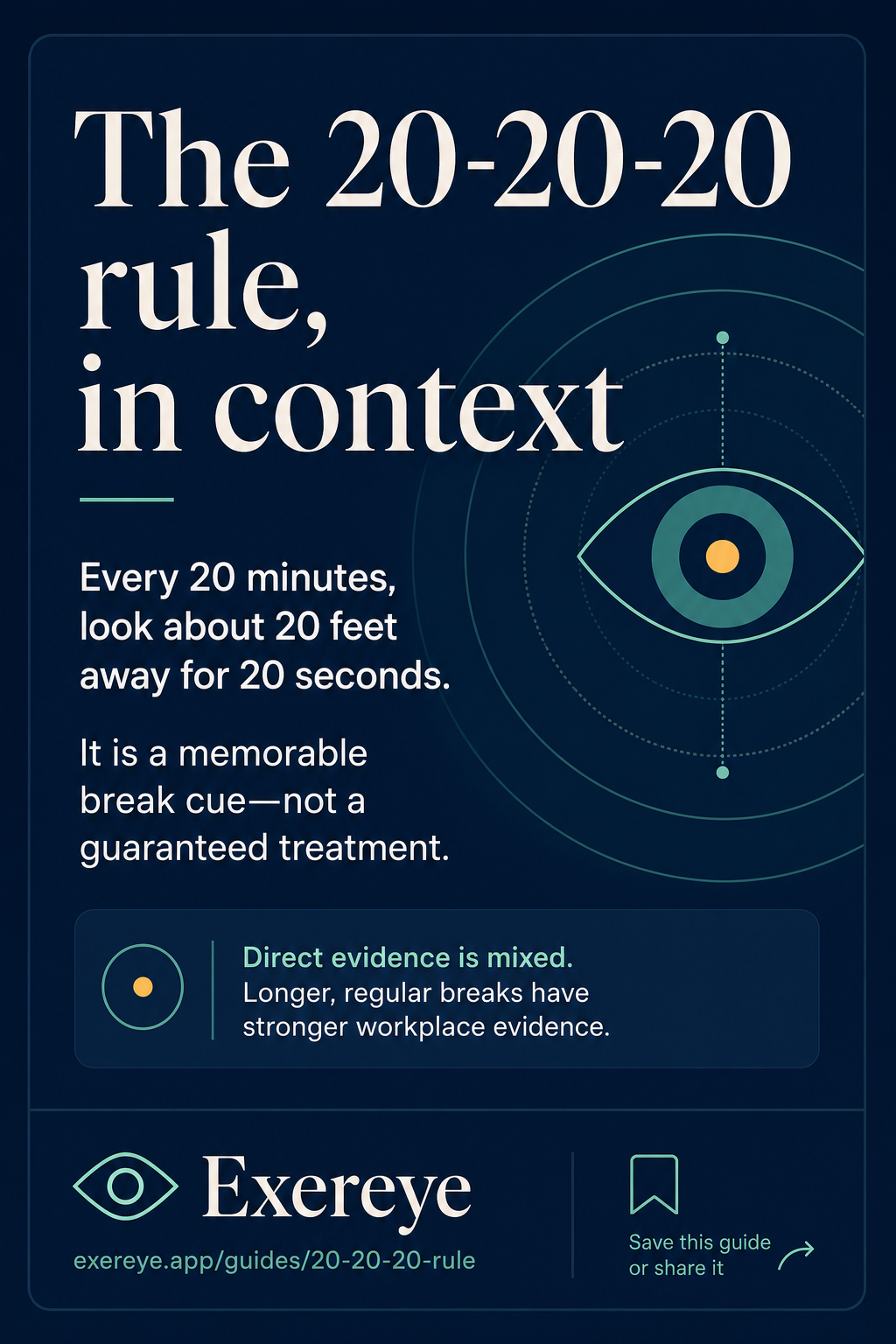
The rule suggests that every 20 minutes, you look at something about 20 feet away for 20 seconds. Its strength is memorability: it gives people a simple prompt to interrupt uninterrupted near-screen work.
Looking at a real distant target changes accommodative demand. Looking at a dot on the same screen does not create the same physical distance change.
What the evidence says
Direct evidence for this exact dose is mixed. A monitored intervention reported improvements, while a controlled comparison of 20-second breaks did not find a symptom benefit. That means the rule should be presented as a practical reminder, not as a proven treatment.
Workplace studies of longer supplemental breaks—five minutes each hour—have stronger evidence for reducing visual and musculoskeletal discomfort without reducing productivity. Exereye defaults to that evidence-backed cadence while still offering 20-20-20 as an option.
A practical way to use it
Keep the cue gentle and pair it with normal blinking. Stop any movement that feels uncomfortable.
- Choose a real object across the room or outside a window.
- Let your gaze settle rather than forcing clarity.
- Blink comfortably and relax your shoulders.
- Use a longer break when a short glance is not enough.
Questions people ask
Does 20-20-20 cure digital eye strain?
No. It is a memorable break cue, not a cure or guaranteed treatment.
Does looking across the screen count as 20 feet?
No. Use a real distant target; the screen remains at one physical distance.
Can I take longer breaks?
Yes. Longer, regular supplemental breaks have stronger workplace evidence than the exact 20-second dose.
Primary sources and further reading
Save a reminder. Share the context.
Keep this card handy, or share it with someone who spends long days at a screen.